
How to Search Criminal Dockets
For a felony or a general district-court case, the clerk's Online Access page is the starting point. It is reached through its Cott eSearch route. The coverage table there lists criminal and traffic indices and images. They go back to July 1, 1990. That access costs money, since the local service runs on subscriptions. Check what your tier includes before you pay. The clerk's public material does not show the exact Cott search fields. So enter the case number exactly as the court issued it rather than guessing a format. Guesswork wastes paid time.
A second statewide route, eClerks LA, carries criminal minute entries. It can help you spot a covered parish result. Still, it is no substitute for the Sabine Parish record. And it will not confirm a current setting. Keep the court named on any citation, summons, or notice in front of you. Mayor's Courts and Justice of the Peace courts hold their own records separately.
- Identify the issuing court, the person or party name, and the approximate filing date.
- Use the local Cott route for a Sabine Parish district criminal record where its coverage applies.
- Use eClerks LA Criminal Search to narrow a statewide name search by parish and dates.
- Open the matching record and preserve the clerk-issued case number and latest minute date.
- Call the clerk or 11th Judicial District Court to confirm a live setting or request an official copy.
Sabine Parish Cott Criminal Coverage
The clerk's Cott login handles account creation and renewal. It also warns that passwords are case-sensitive. Pricing is posted up front: $20 buys 24 hours, $100 one month, $300 three months, and $1,200 a full year. Those figures buy access. They do not promise that every document or image is available at every tier. The public source itself advises confirming before purchase.
Coverage has a hard edge, too. Criminal and traffic indices and images run from July 1, 1990 forward. Anything older may take a phone call, a trip to the courthouse, or a written request. The same goes for anything restricted or from a lower court. Repeated online docket searches will not change that. Also note that the clerk's criminal pleadings notice describes how to file papers with the court. It does not explain how to pull up a public docket view. Filing and searching are two different tasks. Read the clerk's criminal pleadings information for that filing channel before you conflate the two.
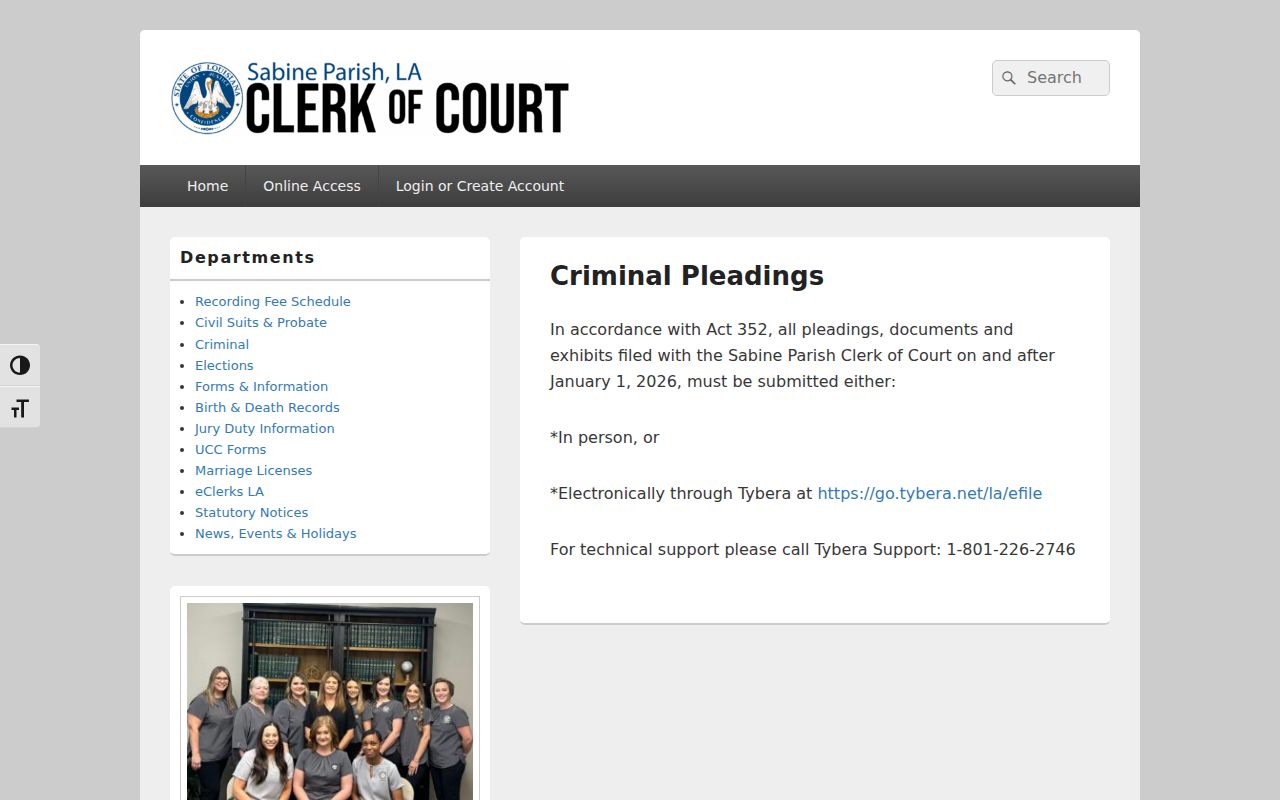
The distinction matters: filing criminal papers with the clerk is one process, and locating a public Sabine Parish criminal docket is another.
What a Criminal Docket Shows
A criminal docket is the timeline of a case, not the whole file. A Sabine Parish result can show the case number, the date filed, the defendant block, charge information, proceedings, and later minute details. Those items appear when they are supplied. The statewide criminal guide shows what a typical result row holds: defendant, case, filed date, charges, parish, and alert fields. Its detail view adds a dated minute-details table. Treat a name-result as a lead, not an outcome.
| Case number | The clerk’s unique identifier. Sabine does not publish a public case-number grammar, so use it exactly as returned. |
|---|---|
| Charge block | Charge filing, amendment, or dismissal information when the record provides it. |
| Minute details | Dated entries for appearances, motions, rulings, pleas, trial activity, and other action. |
| Setting | An arraignment, plea-status, pretrial, motions, or trial-related event that still needs current confirmation. |
| Disposition | The recorded outcome, read with any sentence, costs, or later appeal entry. |
Note: A docket entry can point to a filed order or judgment. The underlying paper, or a certified copy, is a separate clerk product you must request.
Sabine Parish Criminal Minute Access
La. R.S. 13:5992 requires electronic public access through LCRAA to criminal minute entries or summaries for covered cases filed on or after January 1, 2020. That statute built a useful statewide access layer. It does not promise the full set of filed images for every case, though, and it expressly leaves traffic violations outside this particular transmission rule.
The statute's structure also explains why eClerks results center on a case number, filed date, charges, proceedings, judge, prosecutor, and dated minutes. For a plain, conformed, or certified copy, the Sabine Parish clerk remains the office to call. The published statutory text is the source for the electronic minute-entry rule.
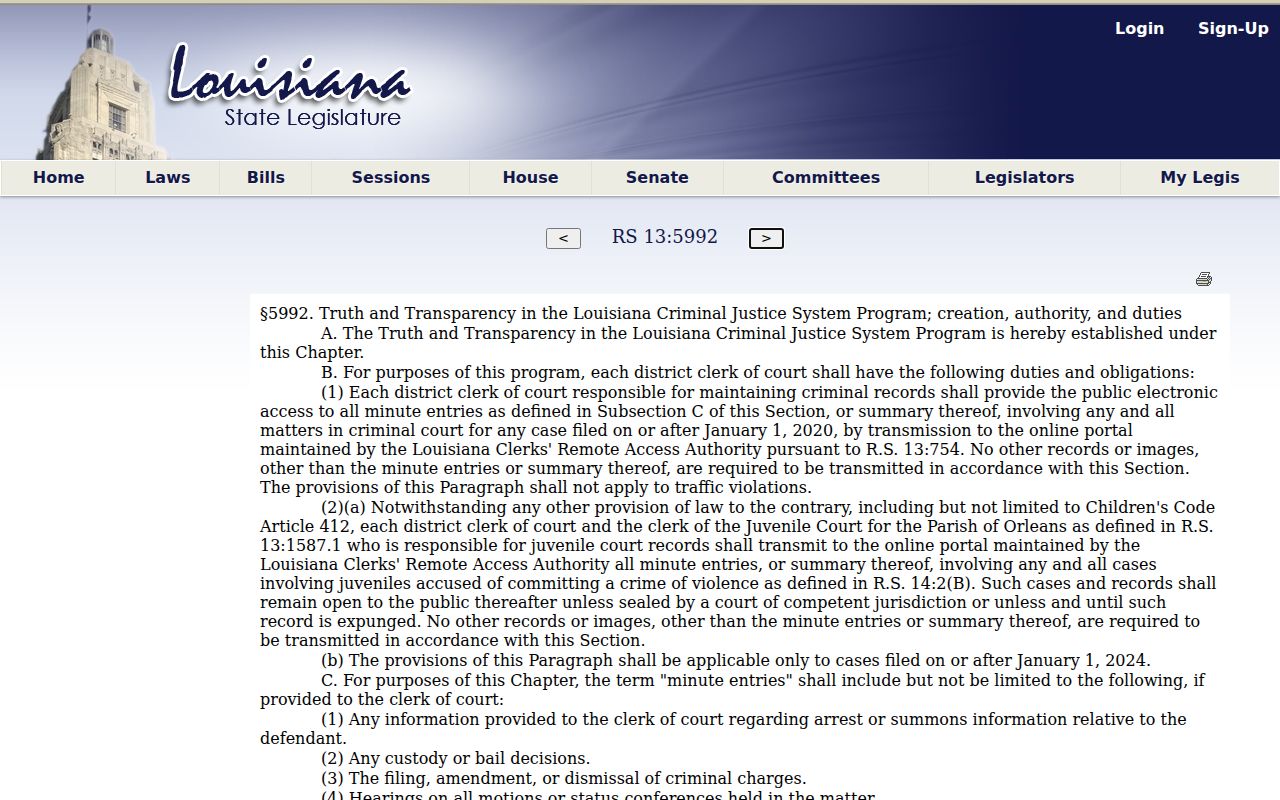
The statute creates limited electronic access. It does not turn a statewide result into the official certified record. The print version of the minute-entry statute states the same rule in the state code.
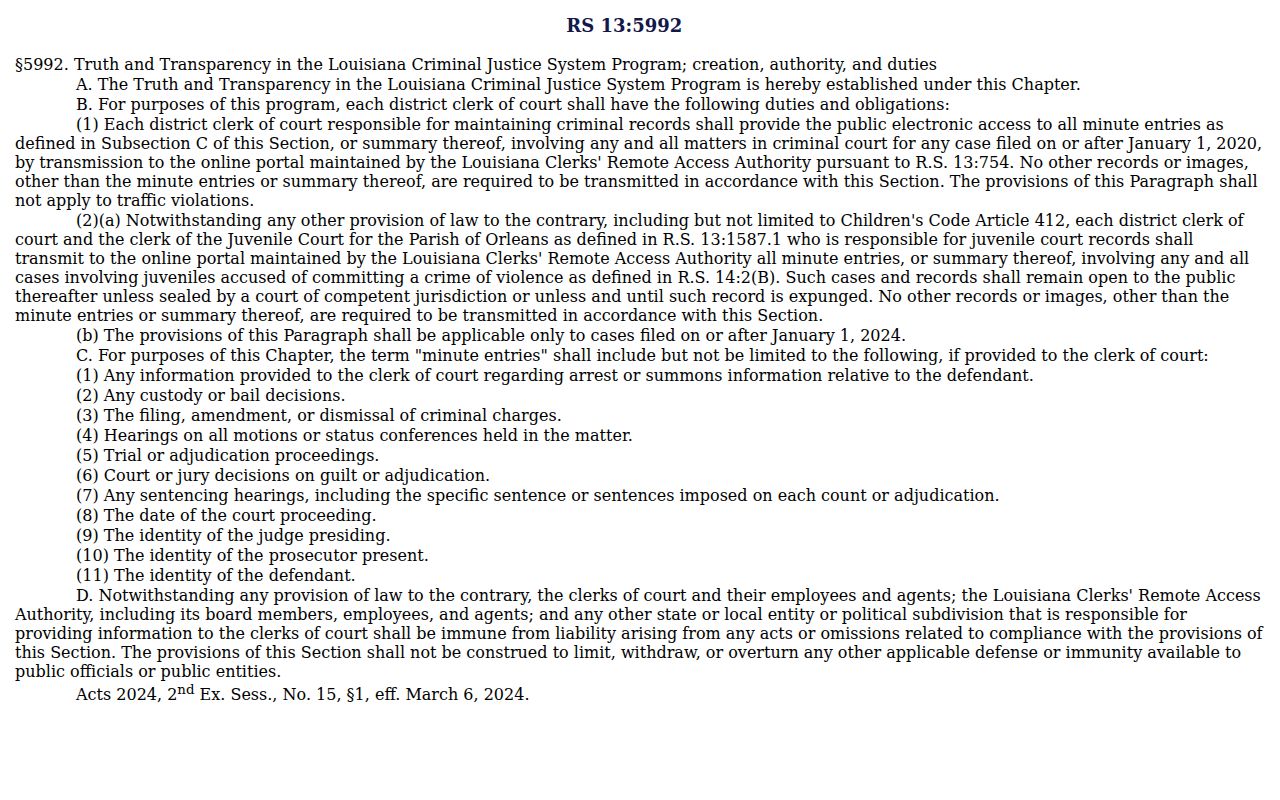
The printed statutory source confirms one more limit. The statewide criminal minute rule does not supply a general traffic-ticket search.
Stages on a Criminal Docket
A district criminal record often moves through a recognizable sequence: filing or charge → arraignment → plea status or pretrial → motions → plea or trial → disposition → sentencing or costs → appeal. The exact path varies by case. A later entry can change an earlier date, and a plea-status entry is case management, not a final judgment.
Sabine's 2026 public calendar uses separate session labels: Arraignment, Plea Status, Pretrial Status, Criminal Motions, Misdemeanor, Fines & Costs, Grand Jury, and Criminal Jury Trial Week. Each label describes a recurring court session, nothing more. For a particular case, the minute entry, signed order, citation, or notice controls.
Sabine Parish Criminal Calendar Times
The clerk's 2026 public calendar includes a time legend worth reading. Criminal jury matters are listed at 8:00. Arraignments, criminal motions, plea status, pretrial status, and fines and costs sit at 8:30, while misdemeanor starts at 9:00. Remember that the calendar is a planning grid. It does not list case numbers, parties, a courtroom, or the presiding judge. It omits those for every specific event. If a record's date seems to clash with the grid, trust the newest case-specific entry. Then call the clerk at 318-256-6223 or the court office at 318-256-9789. A past grid date alone tells you nothing about whether a matter was continued or reset.
Which Court Holds Criminal Dockets
Felony and misdemeanor dockets in Sabine Parish belong to the 11th Judicial District Court. That court is Louisiana's general-jurisdiction trial court for the parish. The Sabine Parish Clerk of Court keeps those district criminal records. So the clerk is where a docket search usually starts. The court sits above the local courts and hears their appeals. From the district court itself, an appeal moves up to the Louisiana Court of Appeal, Third Circuit. That court runs a docket system of its own.
Not every case starts there, though. Justice of the Peace courts and Mayor's Courts keep their own limited files. Ordinance matters belong with the city or town clerk. For a traffic ticket or ordinance citation, read the citation first. It may point to a venue that never touches a district-court criminal docket.
Sabine Parish Drug Court Label
Sabine Parish does have a drug-court track. The 11th Judicial District Court names the initiative. The 2026 calendar lists Drug Court at 11:30. That label confirms a calendar track and nothing more. It does not create a separate public drug-court case search, a participant roster, or a full program directory. A docket entry on a calendar is not the same as a case record.
The court information page and the calendar are the official backing for the program. For anything specific, call the court office or clerk. A setting, a restriction, or a program procedure is a question for staff. It is not a question for a search result.
Public Access and Sealed Criminal Dockets
Public access to a Sabine Parish court docket has hard limits. Under La. Code Civ. Proc. art. 251, the clerk is the legal custodian. Inspection and copying are generally allowed during required office hours unless another law says otherwise. Some records sit outside that general rule. Juvenile matters are confidential under Children's Code art. 412. Expunged criminal records are confidential under Code Crim. Proc. art. 973 except for listed exceptions. Sealed files and protected details can be missing in any court records request. They can also be redacted or restricted.
La. Code Civ. Proc. art. 251 identifies the clerk as custodian and authorizes certified copies.
Children’s Code art. 412 supplies the juvenile confidentiality rule and exceptions.
Code Crim. Proc. art. 973 makes an expunged criminal record confidential except as the statute allows.
An empty search result does not mean nothing happened. Before asking the clerk about lawful access, recheck the court, the date range, name spelling, lower-court venue, and restriction status.
Sabine Parish Expungement Records
Start with the clerk's own 11th Judicial District expungement checklist. Among the materials it can require is a certified minute entry showing final outcome. The fees add up fast. Expect a $200 local clerk fee and a $250 Louisiana State Police fee. A possible $50 Office of Motor Vehicles fee applies to OWI cases. The checklist also notes an objection period and processing time. Those are process details only. They are not advice on whether any one person qualifies.
For what expungement actually does to a record, the official expungement law states the confidentiality result.
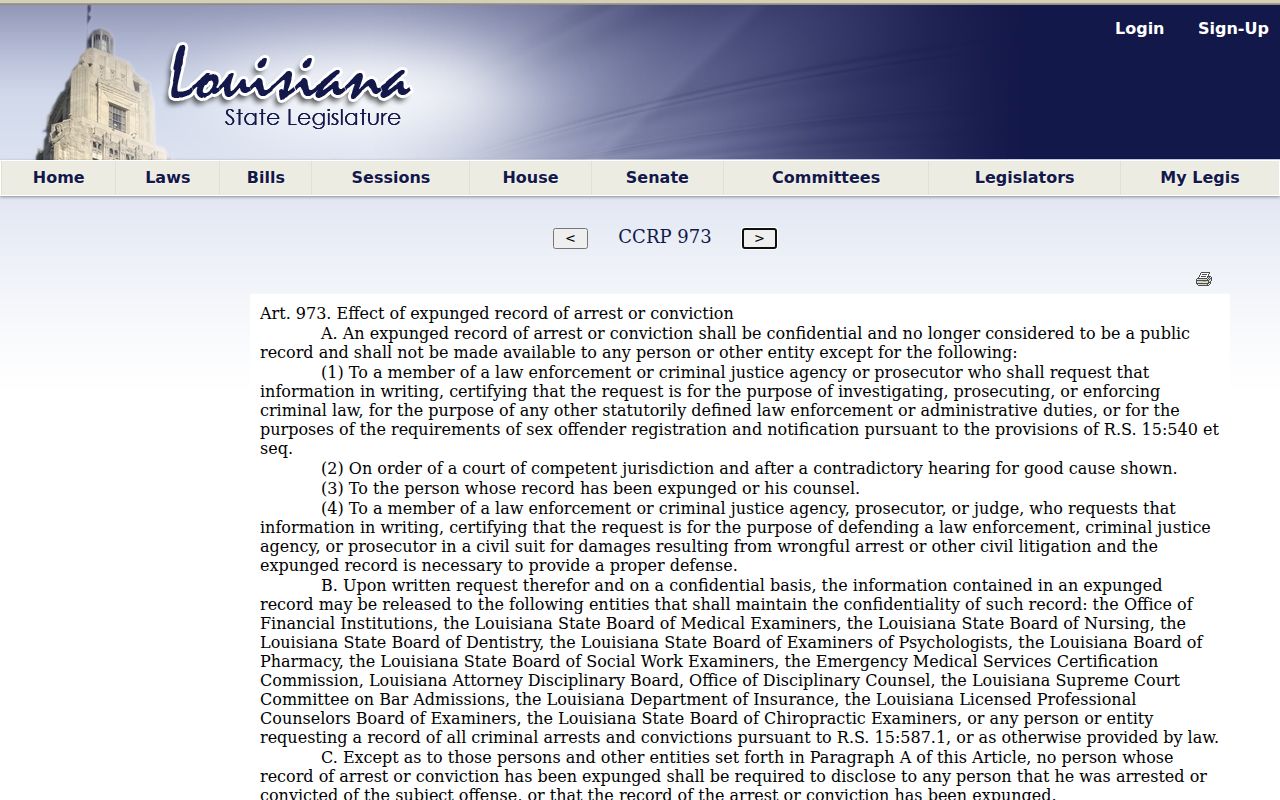
That statute explains the practical effect. After expungement, a Sabine Parish criminal docket may no longer appear in ordinary public search.
Sabine Parish Criminal Filing Change
Criminal filings in Sabine Parish changed course. On and after January 1, 2026, the clerk's criminal pleadings notice directs filings, documents, and exhibits to the Sabine Parish Clerk. That works in person or through Tybera. The platform handles submission. But it offers no public case viewer and no promise of instant images. Filers must also shield personal identifiers under the electronic-filing rules.
Keep the access channels straight. Cott serves local subscription search. eClerks LA covers statewide criminal access. The public calendar shows session types, and the clerk handles copies and record confirmation.
Sabine Parish Criminal Copy Options
Once a docket search lands on the right case, the clerk can produce a plain copy, a conformed copy, a certified copy, or a minute entry. The published charges are $1 per plain page, $3 for a conformed copy, $5 for a certified copy, and $5 for a minute entry, plus actual postage or carrier cost. Ask a few things first. Is the page charge extra? What payment does the office take? Is the record restricted? Get those answers before mailing anything.
The clerk sits in Room 102 at 400 South Capitol Street in Many. Mail requests go to P.O. Box 419, Many, LA 71449. A written request should list the case number, party name, document or minute date, copy type wanted, and return-contact details. The clerk offers no general certified-copy web form and no guaranteed turnaround for criminal record requests.
Sabine Parish Criminal Result Limits
A docket entry can show plenty of court activity. It still cannot replace a certified record or settle every question about a current hearing. Images may be limited by record coverage, subscription access, confidentiality, or the venue that actually kept the case. The smart move is simple. Preserve the case identifier, then ask the proper custodian for the record or setting.
Need to search across case types? Start from the parish's Sabine Parish case search routes. That page compares the local system with the statewide portal and does not assume every lower-court criminal file shows up in both.